
Camera inspection: $300–$750
The first and non-negotiable step. Most operators credit it against the works if you proceed.
A cracked or root-damaged drain does not have to mean a trench through the garden. A resin liner is cured inside the existing pipe from an access point you already have, sealing every joint along the run, and the surface above is never touched.
The failure that brings most people here is not a broken pipe. It is a joint. Older drainage is laid in short lengths, so a single run has a great many joints, and after decades of ground movement and root pressure they open a fraction at a time until something backs up.
A liner seals all of them in one pass, which is why it changes the pattern rather than resetting it. Cutting roots out clears the pipe and leaves the way in exactly as it was, and the interval to the next blockage is set by how fast they grow back.
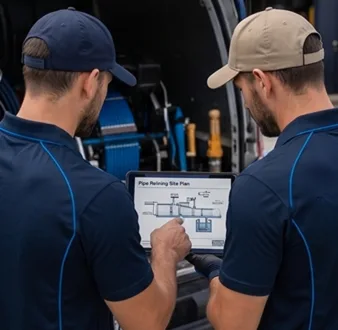

Much of Berowra was built out from the 1950s with earthenware drains that crack and displace on the suburb’s shifting sandstone slopes.
Houses of this era were generally drained in vitrified clay, laid well, and then left alone for sixty or seventy years. The pipe is usually still round and still sound. The joints have had seven decades of ground movement and root pressure.
That combination is close to the textbook relining case, which is why so much no-dig work in Sydney happens on streets built between the late 1940s and the 1960s.
This is the honest limit of the method. A liner follows the pipe it is cured inside. If the run has sagged into a belly or lost its fall, relining seals it and leaves the shape exactly as it was, so the water still pools where it pooled before.
Land drops fast toward Berowra Creek on either side of the ridge, so downpours send torrents of runoff, leaf litter and sand into gully traps and stormwater lines.
On sloping ground that failure mode is common enough to check for specifically. Where the profile is wrong, the correct answer is excavation and re-lay of that section, and we will tell you so even though it is the more expensive quote.
An open joint leaks in both directions. On a low-lying block that means stormwater and groundwater entering the sewer through cracks, which is called infiltration, and it quietly overloads a line that would otherwise cope.
It shows up as a system that backs up in wet weather and behaves perfectly in dry. If that is the pattern, sealing the run is the fix, and no amount of clearing will reproduce the result.
On a clay line the barrel is usually fine. What has gone is the mortar or rubber ring at each joint, and there is one every few hundred millimetres, which is a great many small openings after sixty or eighty years in the ground.
Eucalypts and angophoras bordering nearly every Berowra block drive roots into ageing clay sewer joints, the single biggest blockage cause we see here.
That matters for the quote. You are not replacing a pipe, you are sealing a long series of joints, and a liner does the whole run at once rather than patching them one at a time.
Cutting roots out clears the pipe and does nothing about the way in. The joint they came through is still open, the tree is still looking for water, and the interval before the next blockage is set by how fast it grows back. That is why a jetted line often reblocks on a schedule you could almost diary.
A liner seals the full run, joints included, so there is no opening left to find. It is the one intervention that changes the pattern instead of resetting the clock.
The first and non-negotiable step. Most operators credit it against the works if you proceed.
Domestic sewer across Sydney in 2026. Longer single runs sit at the lower end of it.
Seals one defect. Right where the rest of the run is sound and the ground is stable.
Length, diameter and how many branches need reinstating are what move the number inside that band.
Excavation is only half the cost. Replacing the driveway or garden above it is the other half.
These are market ranges, not our price. Nothing is quoted before the survey, and nothing starts before you agree it. Figures here are indicative of the 2026 Sydney market rather than a quote from us, you get your own number as a fixed price before any work starts.

We find the fault, measure it from an access point, and check the fall is intact. That last check is what stops a liner being installed into a belly.
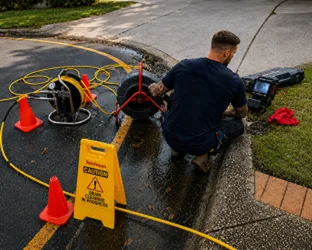
Per metre, with access and junction reinstatement itemised, and the excavation comparison alongside it so you can see both.
Clean, install, cure. One access point, one day for most homes, and no trench across the property.

Branches reopened, final footage, certificate and notification. Keep it with the property file, it is worth real money at sale.
Describe what the drain is doing and how often. We will tell you whether it sounds structural or whether a clean and a maintenance interval is the honest answer.
The questions that come up before every relining job, answered with real numbers.

Phone is quickest. The form reaches the crew covering Berowra, and the first step is always the survey.

Leave your details and our local Berowra team will call you back fast.